
Khon Khlan (Egg Yolk-Egg White): Ban Khlong Khut designs conservation zones based on the community’s actual capacity
After learning from expanding the conservation area beyond its capacity and having to suspend activities for 4 years, Ban Khlong Khut designed “egg yolk-egg white” conservation zones that balance resource protection with livelihoods.
Translated from Thai · reviewed by the CF team
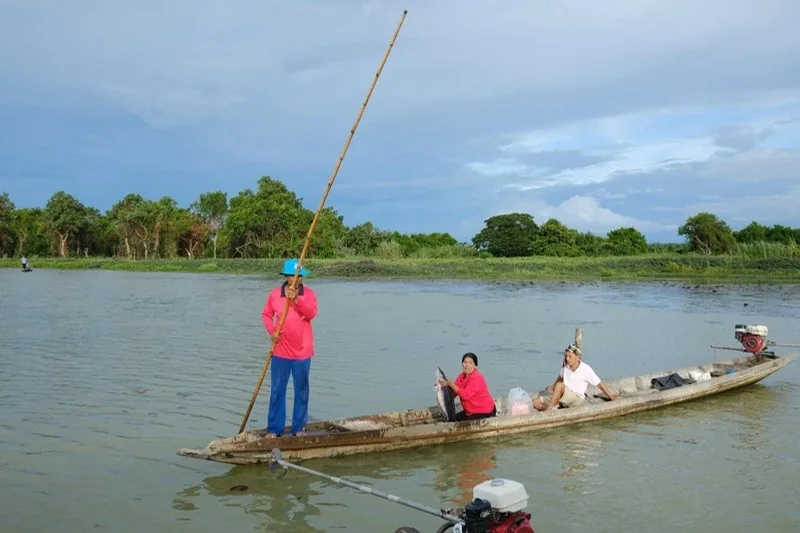
The people of Ban Khlong Khut, Phatthalung Province, migrated from Sathing Phra District, Songkhla Province, and have lived on the shore of the upper Songkhla Lake for almost 90 years. During 1990-1991, aquatic resources deteriorated severely, and daily income from fishing fell to just 150-200 baht. Many villagers had to leave fishing and take up construction work instead. Between 1997-2001, the community tried to expand the conservation area to 450 rai, but it was beyond their capacity to manage. Illegal fishing increased and enforcement of the rules weakened, until conservation activities had to be suspended for as long as 4 years. In 2013, the community decided to scale back the area to 350 rai. This became a key turning point, making monitoring and enforcement of the rules more effective.
Under the Sea Guardians project, the community designed its conservation area using a spatial approach simply called “egg yolk-egg white”. The core zone (egg yolk), covering 340 rai, is a fully protected nursery for aquatic species. The buffer zone (egg white), covering 273 rai, allows fishing for subsistence but prohibits destructive gear. Violators face fines of up to 5,000 baht and confiscation of their equipment. Since the system was established, however, no one has been fined even once. This reflects how community ties can have a stronger deterrent effect than the penalties themselves. A group of 36 fishing volunteers (21 women and 15 men) regularly patrols the area. The high proportion of women reflects a shift in social roles, with women increasingly becoming resource guardians and community leaders.